
Loredana Marcello was the wife of Doge Alvise I Mocenigo and Dogaressa of Venice from 1570 to 1572, when she died at the end of that year. She is the woman on the right in this painting by Tinteretto created circa 1575 and called Doge Alvise Mocenigo and Family before the Madonna and Child, now on display in the National Gallery of Art in Washington, DC, USA.
Marcello was not only important for being the wife of the Doge; she was extremely well educated for the time, a model Renaissance noblewoman, and a writer, poet, and botanist. Reportedly a student of Melchiorre Giulandino, a University of Padua professor, she studied at that city’s Botanical Garden founded in 1545.
Notably she created many formulas to combat the plague, which were apparently used a few years after her death during the Venetian plague epidemic of 1575, which killed about 50,000 people, a third of the entire city’s population. Unfortunately none of her therapeutic recipes are still in existence.
She is one of the women featured in the The Dogeressas of Venice by John Edgcumbe Staley in 1910.
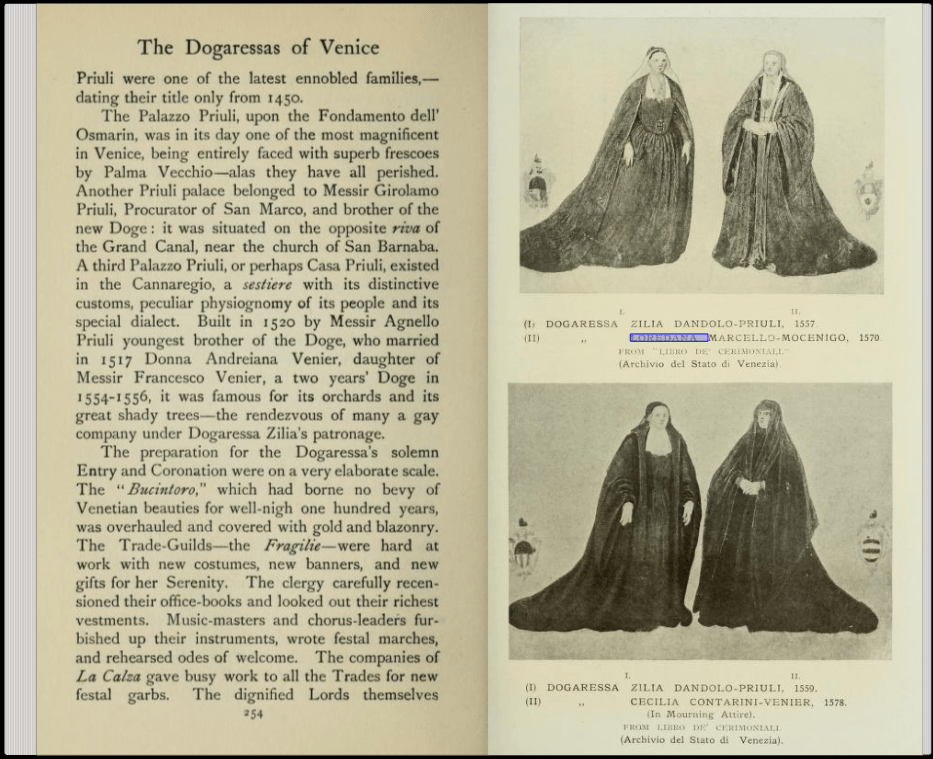
Staley writes that she was “remarkable for her constancy, both in the experiences of adversity and in the distractions of prosperity, judicious and discreet in the supervision of her household, reverent and charitable in her church duties, benevolent to her relatives and her dependents, in a word, she was a most virtuous and noble princess.”
It is unclear how she died but according to one source, her husband the doge was so distraught at her death that five years later he took his own life. The couple are buried together at the Basilica di San Giovanni e Paolo, where all funeral services for doges were held from the 1400s onwards and where 25 doges are buried.
***
RECOMMENDED BOOK: The Maiden of Venice (Katherine Mezzacappa):
In The Maiden of Florence, Katherine Mezzacappa crafts a sensuous and raw story about beauty, sex, sacrifice, and a mother’s undying love, a moving delineation of what it means to be a humble pawn of powerful men finding dignity amid the chessboard of Renaissance Italy.
***
Yours in reading,
Gina

 Gina Buonaguro